
The region
Where this food comes from.
Chettinaad is a cluster of villages in Tamil Nadu's Sivaganga and Pudukkottai districts. Its cooking is among the most distinctive in South India, and among the least well known outside it.
A merchant cuisine
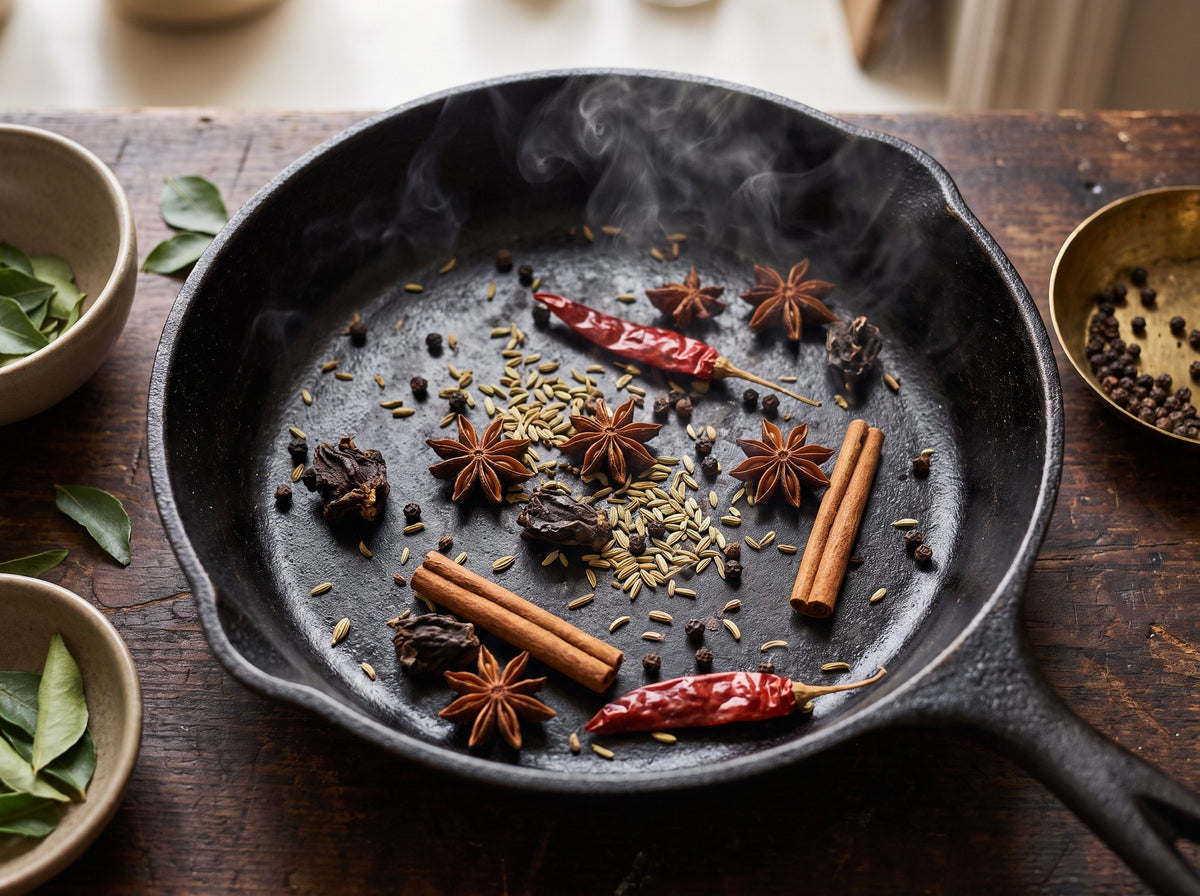
The Chettiars were a trading community whose routes ran through Burma, Malaya, Ceylon and Vietnam. What came back with them changed the cooking: star anise, kalpasi, cinnamon and marathi mokku entered a South Indian pantry and stayed.
The result is a regional cuisine with an unusually long spice list and an unusually confident hand with it: more layered than most South Indian cooking, and quite unlike the coconut-forward food of the Keralam coast.
Pepper, not chilli
The heat in Chettinaad food comes primarily from black pepper. It builds behind the spice rather than sitting in front of it, which is why a dish can be genuinely hot without ever tasting sharp.
That's also why our heat scale runs on its own terms rather than against a takeaway menu. A three-pip Chettinaad dish is warm and deep, not aggressive.
Dry masalas, roasted fresh
Most of the region's signature dishes start with whole spices roasted and ground for that dish, that day. It's slow, it doesn't scale easily, and it's the single biggest difference between Chettinaad food cooked properly and Chettinaad food cooked quickly.
We roast and grind in-house on cooking days. It's the main reason production runs to two days a week rather than five.
What we don't do
We're not claiming to reproduce a specific family's recipe or a specific village's version. Chettinaad cooking varies house to house, and anyone telling you there's one authentic version is selling something.
What we do is cook it the way the region cooks it (long, pepper-led, with masalas ground the same day) and standardise it enough to make the same dish twice.